Christian Wirtz has been part of the Sonuscore family for some years. As a composer and producer specialising in game and film music, he brings years of hands-on scoring experience to every library he creates. His work spans medieval fantasy, cinematic orchestral, and hybrid scoring, with credits across major game productions. He’s also a guitarist, a studio owner, and the kind of person who spends two years perfecting a product before releasing it.
For FANTASY VOCAL PHRASES, Christian worked alongside his wife, Katharina, a professional vocalist whose credits include The Elder Scrolls Online: High Isle and other major fantasy game franchises. Together, they’ve created something that fills a genuine gap in the composer’s toolkit.
We sat down with Christian to understand what went into building this library, and why it matters for composers working in fantasy, games, and cinematic scoring.
Where It Started
FANTASY VOCAL PHRASES began with a recording session for The Elder Scrolls Online: High Isle. Christian watched Kathi perform improvised vocals in a language that didn’t exist. Elvish-adjacent. Flowing and mournful. Utterly convincing.
“I’ve been working in game and film composition for years,” Christian explains. “Medieval fantasy, mostly. The Witcher territory, Game of Thrones atmosphere. The music demands human texture. Real breath. Real performance. And watching Kathi work on these sessions, I realised other composers needed access to this kind of material.”
That realisation kicked off a two-year development process.
The Problem with Single-Note Samples
Ask any composer working in orchestral or hybrid styles: getting convincing vocal texture into a track is hard. Sample libraries give you sustained notes, an “ah” here, an “oh” there, but something essential gets lost.
“Single-note samples are building blocks,” Christian says. “But a sustained vowel played on a keyboard will never capture what happens when a trained vocalist commits to a phrase. The micro-timing. The emotional arc. The way consonants and vowels interact across a melodic line.”
This is the fundamental tension in sample-based composition. You want the convenience of a library, with instant access, no session booking, no singer availability issues. But you also want the unmistakable quality of a real human performance.
Phrase libraries attempt to bridge this gap. But most come with significant limitations.
“A lot of phrase libraries lock you into specific melodies, specific moods, specific keys,” Christian notes. “You find something that almost works, but the tonality is wrong, or the phrasing doesn’t fit your tempo, or the emotional colour clashes with what you’re building. Useful sometimes. Limiting always.”
FANTASY VOCAL PHRASES was designed to solve these problems directly.
What “Fantasy” Actually Means
The name is deliberately broad. We’re talking The Witcher. The Elder Scrolls. The Lord of the Rings. Game of Thrones. Dragons and elves and ancient kingdoms. Mournful solo lines floating above orchestral textures.
But there’s a crucial distinction that shapes the entire library: the difference between constructed languages and improvised fantasy language.
“Tolkien’s Elvish is a fully developed linguistic system,” Christian explains. “It has grammar. Etymology. Internal logic. That’s not what we’re doing here. What we’ve created sits in a different space. Improvised fantasy language. It sounds like speech. It feels like meaning. But there’s nothing to translate.”
This approach emerges directly from professional game scoring practice. When Christian and Kathi work on major franchise soundtracks, they’re rarely asked to sing in actual constructed languages. The production teams want something different. Vocal performances that exist somewhere between real language and pure vocalisation.
“You get the liveliness of real language without anything recognisable,” Christian says. “No subtitle required. No translation risk. No worried emails from localisation teams asking what the singer is actually saying. Just pure vocal texture that implies ancient, otherworldly communication.”
The phonemes feel familiar. The phrasing suggests syntax. But the words themselves are invented in the moment, shaped by the musical line rather than any dictionary.
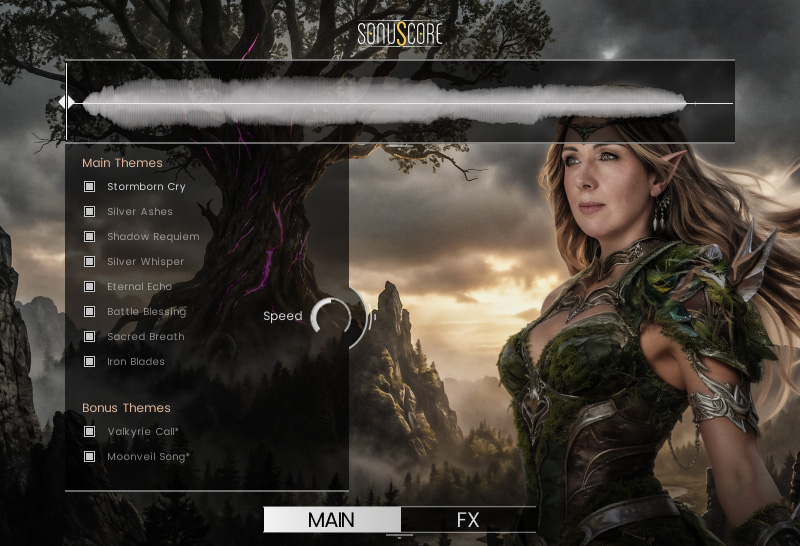
The Sound: Ethereal, Flowing, Minor
Fantasy rarely lives in major keys. The genre gravitates toward melancholy, toward yearning, toward vast emotional landscapes that suggest loss and longing. The vocal performances in FANTASY VOCAL PHRASES reflect this.
“Ethereal is a good word for it,” Christian says. “Flowing. Soft. Predominantly minor tonality, because that’s what the genre demands.”
Think of that solo female voice in every The Lord of the Rings trailer. The one that makes you feel something vast and melancholic before a single word of dialogue lands. That’s the sonic territory this library occupies.
But “ethereal” doesn’t mean “limited.” The phrases cover a substantial emotional range within the fantasy genre. From quiet introspection to dramatic climax, from intimate solo moments to phrases that could ride above full orchestral textures.
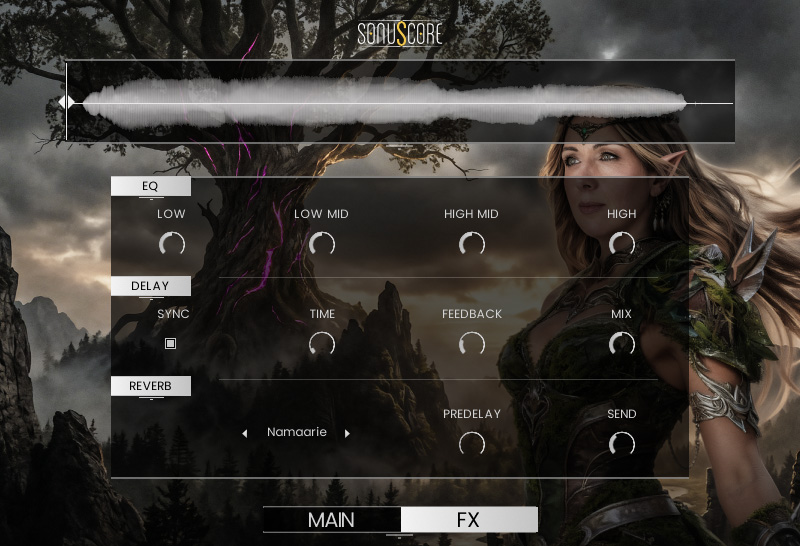
“We recorded in our home studio,” Christian explains. “Everything captured dry. The instrument includes a dedicated reverb section, so you get a production-ready sound out of the box. Full, finished, ready to drop into a mix. But you can strip it back entirely. Add your own processing. Shape the sound to fit your track.”
This flexibility was a deliberate design choice. Some composers want instant gratification, a phrase that sounds finished the moment they play it. Others want raw material to process through their own signal chains. FANTASY VOCAL PHRASES allows for both approaches.
Tonality and Key Matching
One of the most frustrating limitations with phrase libraries is key compatibility. You find a perfect phrase, it’s the right mood and the right length, but it’s in the wrong key for your track. Pitch-shifting introduces artefacts. The phrase becomes unusable.
FANTASY VOCAL PHRASES is designed to deal with this very issue.
“Every phrase is available in all twelve keys,” Christian says. “That’s the first thing you do when you load the instrument. Match the key to your track.”
This isn’t simple pitch-shifting applied to a single recording. The multi-key approach means composers can select phrases based purely on musical and emotional criteria, knowing that tonality will never be a blocking issue.