
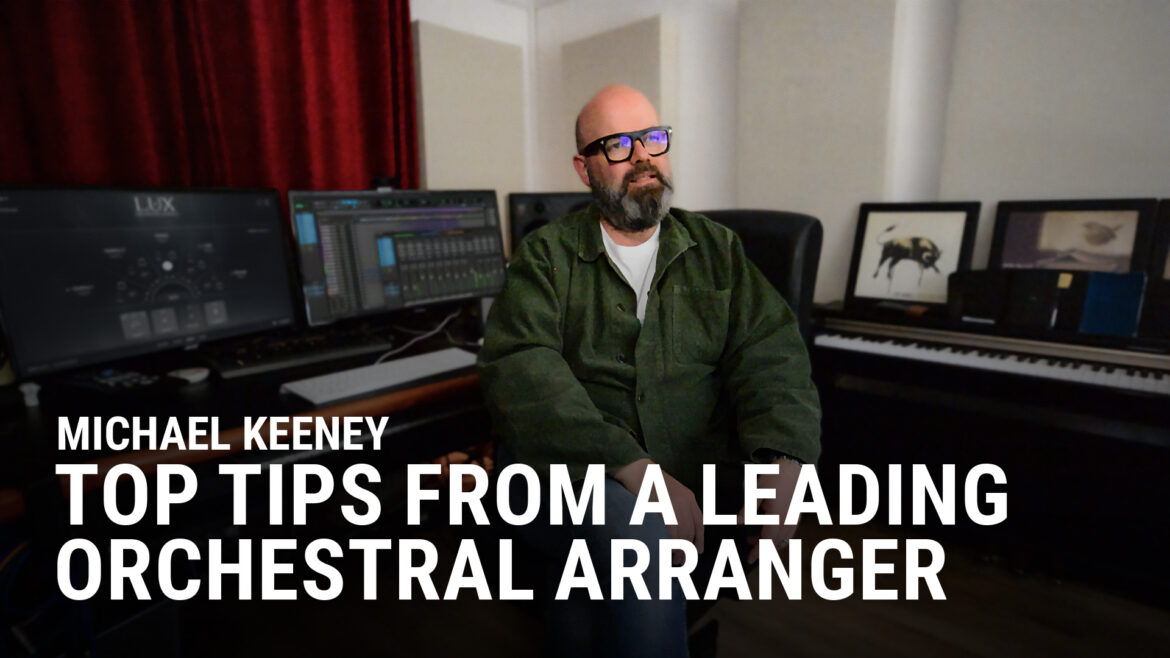
Top Tips From a Leading Orchestral Arranger, For Those Just Starting Out
Michael Keeney is a Donegal-born composer, arranger, and record producer based in Northern Ireland, with close to thirty years of experience across records, film, and television. His credits include Snow Patrol, Foy Vance, Duke Special, Lisa Hannigan, Van Morrison, Villagers and Hannah Peel, alongside orchestral work with the National Symphony Orchestra of Ireland, the Ulster Orchestra and the RTÉ Concert Orchestra. He has scored and mixed for Disney, the BBC, Netflix, HBO and Sky, is a two-time UK Music Producers Guild Award winner, and sits on the board of the Ulster Orchestra and the Ivors Academy All-Ireland Council.
Most people who want to arrange for orchestra never get near one. They learn from samples, from templates, from whatever’s in front of them. Michael has spent three decades on the other side of that bridge: writing for real players, standing in front of real sections, and finding out what works and what doesn’t.
We sat down with him to talk about what he wishes he’d known starting out. Here’s what came out of it.
Start With Strings
If you’re arranging pop, crossover or production music, strings will make up the bulk of your work. Michael puts it at around 75%.
His advice for anyone starting from zero: begin with a string quartet arrangement. It forces discipline. You learn the ranges, you learn the alto clef for viola, and you learn fast that a sample library’s idea of “strings” and a real string section are not the same.
“When you get down to a string quartet, it’s quite a small thing, and very fragile. One violin on its own makes a completely different sound to eighteen violins. I think of those as basically two different instruments.”
Once string arrangements are solid, woodwind and brass follow. They bring their own complications, such as transposing instruments, but the string foundation carries across.
Make Every Note Earn Its Place
The biggest trap for newer arrangers is having too much at your disposal and using it all. Seventy or eighty musicians sitting in front of you is an invitation to fill every bar.
Michael’s rule is the opposite: be economical. A brass section doing nothing for two minutes, then landing exactly at the right moment, means more than brass playing constantly through the whole piece.
“If you’re just filling in space on a score for the sake of looking like you’re doing something, you’ve taken the focus somewhere else. We’re making music, not sound, and music has to mean something. So every note has to mean something too.”
The same logic applies to live shows, where balance works more like a mix than a page of notation. Write four-part divisi on a cello section that only has four players, and you’ve written something that physically can’t be heard once a rock band or a PA system is in the room.
Never Skip A Rehearsal
Sample libraries are good enough now that it’s easy to assume you already know how a score will translate. Michael’s view: you don’t, not really, until you’ve heard it live.
“The only way to really learn that is through practical experience, so I never missed an orchestra rehearsal. Following through the page and realising you can’t hear the thing you thought you were going to hear, that’s what makes you a better arranger.”
This is where a lot of demo-based arranging quietly goes wrong. Templates default to enormous section sizes, eighteen first violins, sixteen seconds, when the actual ensemble on the day might be eight-six-four-four-two. What sounds huge in a sample template can vanish on a stage.
Live has taught him discipline; even if you can’t get in front of an orchestra with your own score, listening to an orchestra live at a concert is a good starting point. That’s where you can hear how they sound in real life.
Build From Harmony
Michael’s observation is a pattern he sees repeated: most working arrangers come up as piano players or guitarists rather than as string or wind players. The reason is simple. Harmonic instruments force you to think vertically, in chords, rather than in single lines.
A solid grounding in harmony opens the door to more interesting arranging choices, reharmonising a song rather than just orchestrating the chart as written.
Not every song will tolerate that. But knowing when you can push and when you can’t starts with understanding the harmony underneath the tune.
The New Tools Are Essential
Michael is candid about how much the modern deadline has changed the job. The image of a composer wandering the garden for months waiting on inspiration doesn’t match the reality of most briefs today.
“We overestimate how much time we have to make film scores in the modern age. The reality is, someone’s emailing: can we have the music yesterday? Software really helps composers move things along a lot faster.“
He points to products like THE ORCHESTRA COMPLETE and THE SCORE as an example of tools built for that pace. Play a lead line into them, and you get a sense of the orchestration behind it immediately, rather than sketching a melody on piano and hoping to imagine the arrangement later.
“Things like THE SCORE are software you sit down with and think, ‘ We can use this sound, and it feels natural, it feels inspirational. That’s worth its weight in gold as a composer, something you can respond to and get ideas up and running fast, even if they’re just sketches.“
The point isn’t that software replaces the arranging work. It’s that a fast, musical sketch gets an idea in front of a director or producer quickly and buys the composer time to go back and craft it properly.
“Then we go back and spend time crafting those arrangements, giving them a unique voice that’s more our own.“
Don’t Wait For Permission
Michael never studied orchestration formally. No conservatoire, no Royal Academy. He read the standard orchestration textbooks decades into his career, not before it.
His take on this: don’t let the absence of formal training stop you from starting.
“People who don’t think of themselves as arrangers often become good ones, because they don’t get too caught up in the trappings. I certainly didn’t have the skill to do the flashy stuff. I think that helped me, in a way, to just try and do whatever I thought made sense.”
Originality, in his experience, beats imitation. Arrangers who copy convincingly are valuable in a studio. Arrangers with a recognisable voice are the ones people specifically ask for.
Develop Your Own Voice
This is the thread running through everything Michael said. Being technically capable across many styles is a genuinely useful skill. But it’s not the same as being distinctive.
“The composers who get to the top of that pile tend to have quite distinctive voices, and likewise their arrangements are distinctive. Having a distinctive voice is what will make you a composer or arranger.”
Big-name composers, in his view, aren’t hired purely for musicianship. They’re hired because their sound is recognisable before the credits roll.
Expect The Imposter Syndrome. Everyone Gets It.
Even with thirty years of experience, Michael says he still feels it when he stands in front of an orchestra.
“Anyone who stands in front of a symphony orchestra and doesn’t feel ‘why the hell am I here’, there’s something wrong with that person. It’s still, to this day, quite an intimidating thing.”
His approach in a nutshell: strip away everything outside the room and focus on the actual job, making something that means something, with the people in front of you. That mindset, he says, applies whether it’s a ninety-piece symphony orchestra or a five-piece band in a small studio.
MICHAEL KEENEY
Composer / Arranger / Record Producer